The significant growth of digital infrastructure across all sectors in Indonesia has driven the development of data centers with increasingly large capacities and rising heat dissipation requirements. Behind every server rack operating around the clock is an engineering element that often goes unnoticed by the public but plays a critical role in determining the reliability of the entire system: cooling system design.
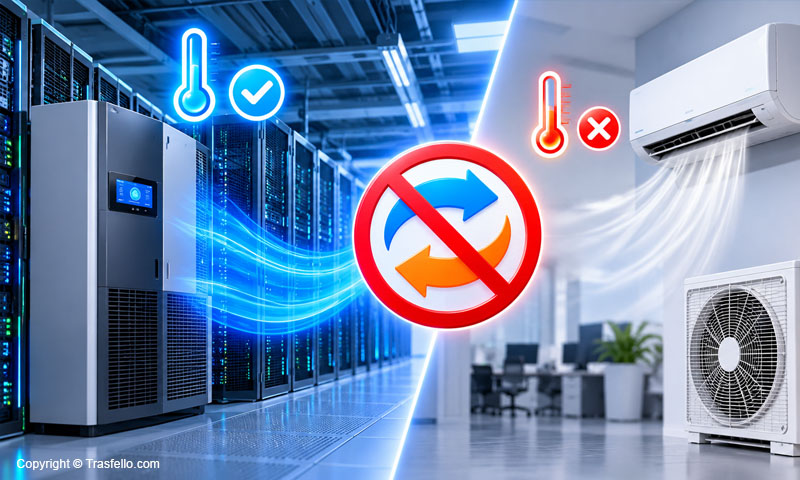
A common mistake, particularly in small- to medium-sized facilities, is treating server room cooling requirements as equivalent to those of ordinary office spaces. However, in terms of design philosophy, thermodynamics, and reliability standards, precision air conditioning and comfort cooling represent two fundamentally different approaches. This article examines these differences from a technical perspective and explores their implications for the operational reliability of mission-critical facilities.
Table of Contents
ToggleDifferences in Design Philosophy
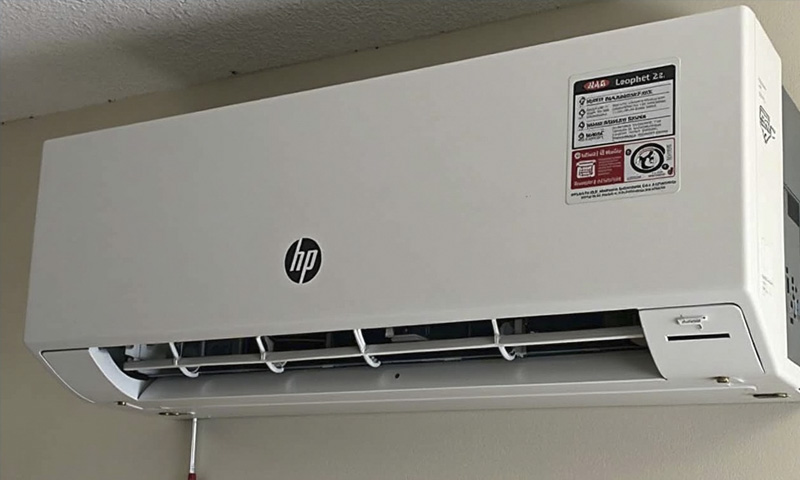
Comfort cooling is designed to regulate the temperature of spaces occupied by people. These systems typically use AHUs/FCUs with chilled water or DX (Direct Expansion) systems to condition and maintain indoor temperatures at comfortable levels for occupants.
Precision cooling, on the other hand, is designed to cool equipment rather than people. The heat generated by server racks is concentrated, constant, and significantly higher per unit of floor area compared to the heat generated by human activities. These systems are required to operate continuously, 24 hours a day, 365 days a year, with virtually no tolerance for operational interruptions commonly associated with conventional comfort cooling systems.
This fundamental difference in design philosophy directly affects equipment selection, system redundancy, and control strategies. It is not simply a matter of differences in cooling capacity measured in BTU/h or TR.
Technical Parameter: Sensible Heat Ratio
One of the key technical indicators that quantitatively distinguishes these two approaches is the Sensible Heat Ratio (SHR)—the proportion of sensible heat (heat removed to reduce air temperature) to the total heat removed, including latent heat (heat removed to reduce moisture content in the air).
Comfort cooling systems generally operate at an SHR of approximately 0.65 to 0.80 because human occupants contribute significant amounts of moisture to indoor environments. As a result, part of the system’s cooling capacity must be allocated to dehumidification.
Precision cooling systems, in contrast, are designed to operate at an SHR approaching 0.90 to 1.0. This means that nearly all available cooling capacity is dedicated to sensible heat removal, primarily to reduce the dry-bulb temperature, since IT equipment does not generate moisture in the same way that humans do.
The practical implications are significant. Comfort cooling units installed in server rooms may cause excessive dehumidification without sufficiently precise control. Excessively low humidity, in turn, increases the risk of electrostatic discharge (ESD), which can damage sensitive electronic components.
Reference Standard: ASHRAE TC 9.9 Thermal Guidelines
The global data center industry refers to the Thermal Guidelines for Data Processing Environments, published by ASHRAE Technical Committee 9.9, currently in its fifth edition (2021), as a primary reference framework for data center environmental design. This standard classifies IT equipment into several categories (A1 through A4, as well as H1 for high-density computing), each with its own temperature and humidity operating ranges.
For Class A1, the most commonly applied classification in commercial data centers, the recommended temperature range is 18–27°C, with relative humidity ranging from 40% to 60%.
An important distinction that system designers must understand is the difference between the recommended range and the allowable range. The recommended range represents the long-term operating target intended to optimize equipment reliability and service life. The allowable range, meanwhile, is designed to accommodate short-term deviations under abnormal conditions, such as when one of the chiller units fails.
Recent developments in these guidelines have also encouraged the use of dew point as a more reliable humidity control metric than relative humidity. This is because dew point is not directly affected by temperature fluctuations and provides a more consistent indication of condensation risk.
Consequences of Thermal Design Failures
Failure to design a cooling system that matches the thermal characteristics of a data center is not merely a matter of comfort; it represents a significant operational reliability risk with potentially substantial financial consequences.
According to the Uptime Institute’s 2024 report, cooling-related issues accounted for approximately 19% of all operational outage incidents at data center facilities. Furthermore, more than half of data center operators experiencing significant incidents reported financial losses exceeding USD 100,000 per incident.
Several common failure mechanisms associated with the use of comfort cooling in mission-critical environments include:
- Uneven air distribution: This can create localized hot spots in high-density server racks, potentially causing equipment overheating.
- Inaccurate humidity control: Improper moisture management increases the risk of corrosion and electrostatic discharge.
- Limited continuous-operation capabilities: Conventional systems may not be designed for uninterrupted operation, potentially accelerating component wear and increasing maintenance-related downtime.
Implications for System Planning
Based on the discussion above, it is clear that data center cooling system planning requires a fundamentally different engineering design approach, starting from cooling load calculations and equipment selection through to system redundancy strategies.
Heat load calculations cannot follow the same methodology used for conventional office buildings. This is because server room thermal loads are predominantly sensible, remain relatively constant over time, and are concentrated at specific locations depending on server rack layouts and configurations.
As a contractor with experience delivering precision air conditioning projects for data center facilities across various locations, Trasfello understands that cooling system reliability in mission-critical environments is not simply about meeting the required capacity figures. It is about ensuring that the system design accurately reflects the thermal characteristics of the load it must serve throughout the facility’s operational lifecycle.
References
- ASHRAE Technical Committee 9.9. Thermal Guidelines for Data Processing Environments, 5th Edition (2021).
- Trane Commercial. “Comfort Cooling vs. Precision Cooling for Data Centers.”
- Data Aire. “Precision Air Conditioning vs. Comfort Cooling.”
- STULZ. “Precision Cooling vs. Comfort Cooling.”
- Uptime Institute. Annual Outage Analysis, 2024.