Trasfello.com – Electrical systems and control are the backbone of modern industrial, commercial, and building operations, because they manage how electrical power is generated, distributed, monitored, and used safely and efficiently. These systems combine power hardware (switchgear, breakers, transformers) with control hardware (relays, PLCs, drives, sensors, and HMIs) so machines, processes, and entire facilities can operate reliably with minimal downtime.
Table of Contents
ToggleWhat are electrical systems and control?
An electrical system covers everything from power sources and distribution equipment to final loads such as motors, HVAC units, and lighting circuits. Control is the layer that decides when and how that electrical system operates, using logic, measurements, and protection devices to keep voltages, currents, and sequences within safe limits. Together, electrical systems and control form integrated solutions that support automation, energy efficiency, and safety in plants, data centers, commercial buildings, and infrastructure.
Main power distribution components
Electrical systems and control always start with safe power distribution from the grid or generators to panels and loads.
- Service entrance and main disconnects: Bring utility or generator power into the building and provide a single point to disconnect the entire installation in an emergency.
- Switchgear and switchboards: House circuit breakers, busbars, meters, and protective relays to route power to different parts of the facility while coordinating fault protection.
- Transformers: Step voltages up or down (for example from 13.8 kV to 480 V) to match equipment requirements and reduce distribution losses.
Electrical control panels and enclosures
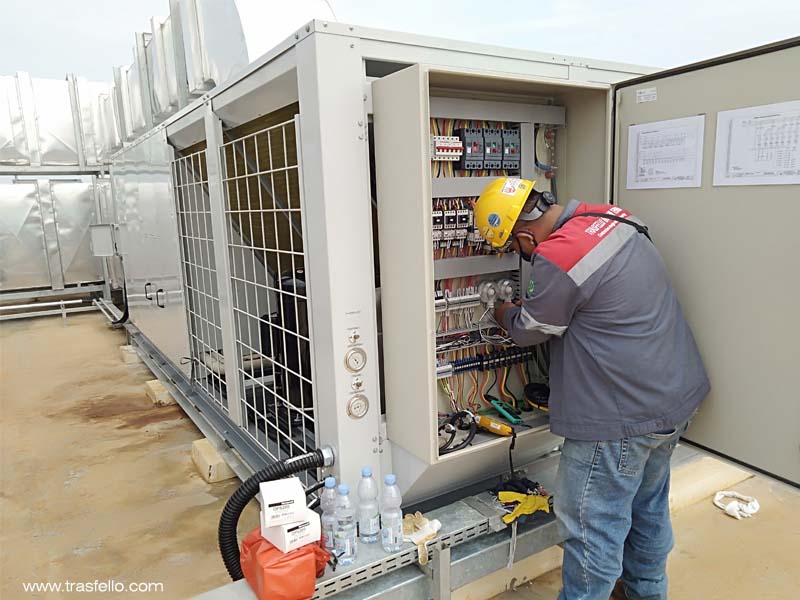
In most electrical systems and control architectures, the “brain and nerves” are built into control panels. These panels are metal enclosures that group components such as contactors, overload relays, PLCs, terminal blocks, and power supplies, arranged according to standards and the application.
- Power sections handle feeders, motor starters, soft starters, and variable frequency drives.
- Control sections carry low-voltage wiring, PLC I/O, relays, and interface modules that implement logic and sequencing.
- Environmental ratings (NEMA/IEC types and IP ratings) ensure panels survive dust, moisture, vibration, or corrosive atmospheres in industrial locations.
Key power management and protection devices
Protective components prevent damage from overloads, short circuits, and abnormal grid conditions in electrical systems and control setups.
- Circuit breakers and fuses interrupt fault currents in milliseconds to stop fires and equipment damage.
- Motor protection (overloads, thermal relays) trips on sustained overcurrent, phase loss, or imbalance.
- Surge protection devices (SPDs) divert transient overvoltages from switching or lightning away from sensitive electronics.
- Protective relays monitor currents, voltages, frequency, and phase angle to detect faults and send trip signals to breakers in larger systems.
Motor control, drives, and starters
Because motors often consume 60–70% of industrial electricity, motor control is central to electrical systems and control engineering.
- Direct-on-line and soft starters provide basic starting and stopping while limiting inrush current and mechanical stress.
- Variable Frequency Drives (VFDs) adjust motor speed by controlling supply frequency and voltage, saving significant energy in pumps, fans, and conveyors.
- Motor control centers (MCCs) group starters, drives, protection, and disconnects in modular sections so maintenance and expansion are easier.
Control logic: relays, PLCs, and DCS
Traditional relay logic has largely evolved into programmable platforms, but all are part of electrical systems and control.
- Electromechanical and solid-state relays still perform simple on/off logic, interlocks, and signal isolation.
- Programmable Logic Controllers (PLCs) execute ladder or function-block programs, managing sequences, interlocks, timing, and PID loops for machines and lines.
- Distributed Control Systems (DCS) coordinate large continuous plants (power, chemical, oil & gas) with thousands of I/O points, advanced control, and centralized operator stations.
✅ Read Also : Electrical Solution for Efficient Power Management
Sensing, measurement, and feedback
Accurate feedback is what allows electrical systems and control architectures to keep processes stable and efficient.
- Electrical measurement: Current transformers (CTs), potential transformers (PTs), power meters, and energy analyzers measure kW, kVA, power factor, harmonics, and energy use.
- Process sensors: Temperature, pressure, level, and flow transmitters feed signals into PLCs or DCS for coordinated control of motors, valves, and heaters.
- Status and position switches: Limit switches, proximity sensors, and encoders report equipment state and position for safe sequencing.
Human–machine interface and communications
Modern electrical systems and control rely heavily on digital communication and intuitive interfaces.
- HMI panels show one‑line diagrams, alarms, motor status, and trends so operators can start/stop equipment, adjust setpoints, and acknowledge faults.
- SCADA systems aggregate data from multiple panels, substations, or sites to a central control room for high‑level monitoring and historical analysis.
- Industrial networks (Ethernet/IP, PROFINET, Modbus, CAN, fieldbus) replace many hardwired signals and allow devices such as drives, meters, and I/O blocks to share data and diagnostics over a single cable.
Safety, codes, and functional protection
Beyond hardware, safety and compliance are core to well‑designed electrical systems and control.
- Interlocks and emergency stop circuits ensure machines stop safely when guards open or E‑stop buttons are pressed.
- Lockout/tagout, labeling, and documentation reduce human error and make maintenance safer and faster.
- Safety standards such as NFPA 70 (National Electrical Code), NFPA 70E (electrical safety in the workplace), IEC 60204 (machine safety), and IEC 61508/62061 (functional safety) guide design, installation, and operation.
✅ Read Also : Essential Control Instrumentation Components for Industrial Success
Connective and auxiliary components
Smaller parts are sometimes overlooked but are essential to reliable electrical systems and control.
- Terminal blocks and wiring ducts organize connections and simplify troubleshooting.
- Power supplies and UPS units provide stable low‑voltage DC for PLCs, sensors, and HMIs and keep controls running during brief outages.
- Contactors, auxiliary relays, and timers implement local interlocks, delays, and backup manual control functions.
Typical applications of electrical systems and control
These integrated systems support a wide range of use cases:
- Industrial plants: Motor control for conveyors, mixers, compressors, and process lines.
- Commercial buildings: Lighting, HVAC, and generator controls for comfort and reliability.
- Data centers: Redundant power paths, UPS systems, and automatic transfer switches to maintain uptime.
- Infrastructure and utilities: Pump stations, treatment plants, and substation automation for water and power networks.
✅ Read Also : 7 Powerful Electrical automation Solutions You Must Know
Summary of components in electrical systems and control
Electrical systems and control, when properly designed and maintained, provide safe, efficient, and flexible operation for virtually every modern facility. A structured approach that covers power, control, protection, communication, and safety will always outperform ad‑hoc wiring and standalone devices in reliability, scalability, and lifecycle cost.